My second sketch and my third sketch share the exact same faint crease beside the left eyebrow, and the two of them landed in my inbox within the same week. That's not a feeling, a vibe, or an intuitive hit — it's a reproducible detail you can hold up next to another reproducible detail and ask a flat yes-or-no question: is this a genuine psychic drawing, or is it the same template running through two different inboxes, repackaged as a personalized soulmate sketch.
Three years and four services into testing these things, I've narrowed the real question down to a handful of concrete checks, not vibes. They're the same instincts you'd use vetting a secondhand marketplace listing, a dating profile photo that looks suspiciously flattering, or a horoscope app that somehow nails your Tuesday. None of it requires any psychic ability on your end: just the willingness to treat a soulmate sketch scam with the same suspicion you'd give any other online reading that shows up asking for your trust before it's earned it.
Start With the File, Not the Face
Before you even look at the face, open the file the way you'd vet a used listing on a resale app — because functionally, that's what you're doing. Drop it into a reverse image search like Google Lens or TinEye; both index enormous swaths of the internet looking for duplicate visual fingerprints. If your psychic artist just grabbed an appealing stock illustration or a public Pinterest board and layered a sepia filter over it, a reverse search tends to surface the original fairly fast. I've had a "custom" drawing match an uncredited stock illustration that had simply been recolored.
File specs matter just as much as the picture search. A real digital artist exporting from Procreate or Photoshop for print will hit at least 300 DPI, sized to a clean 8.5 by 11 inches — standard letter paper, nothing stretched or cropped oddly to fit. A blurry, heavily compressed 72 DPI thumbnail that pixelates the second you try to print it is usually a sign you're looking at a mass-scraped asset, not a one-off drawing made for you specifically.
A follower named Naomi mentioned she saves every digital attachment to her camera roll the second it lands, before she even opens the preview, so she always has one untouched copy to compare against whatever she eventually prints. It sounds excessive until you realize that's exactly the kind of raw file you need for this — a resized screenshot or a recompressed export can quietly scrub the very details you're trying to check.
Does the Online Reading Sound Like It's About You, or About Everyone?
Every sketch comes with a written profile, and the text usually tips the hand faster than the drawing does. Vague lines — calm exterior, deep private feelings, heartbreak that taught resilience — are what psychologists call the Barnum effect: statements broad enough to fit literally anyone, dressed up as a specific insight about you. It's the same trick a free personality quiz pulls when it tells you that you're "secretly more sensitive than you let on."
I've gone through how to read a soulmate sketch description without getting fooled by fluff line by line elsewhere, so I won't repeat the whole breakdown here. The short version: count how many sentences could describe your coworker, your mail carrier, and a stranger on the train equally well, then count how many land on something oddly specific — a vocational detail, an unusual habit, a trait anchored in actual behavior instead of mood lighting. A reading that's almost entirely the first category is filler. One with even a couple of the second is at least trying.
Why Two "Original" Sketches End Up Looking Like Twins
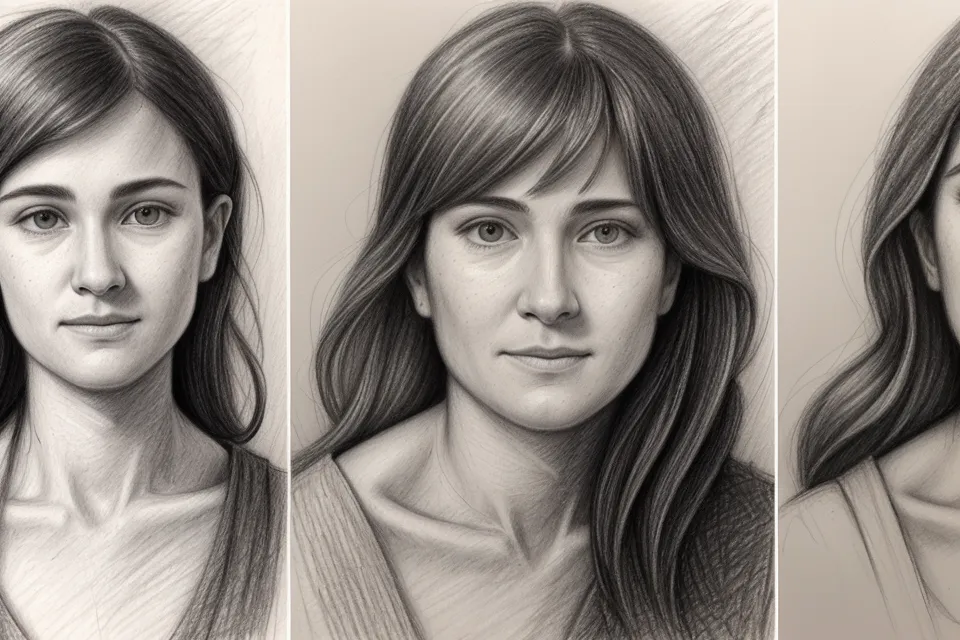
Look, once you've stared at enough of these side by side, mechanical patterns jump out whether you're hunting for them or not. The hair is usually the easiest tell: mass-production artists lean on pre-made brush stamps that lay down identical curl clusters, so three clumps on the left can match three clumps on the right pixel for pixel, which a real hand almost never repeats twice. Faces are the second tell: genuine human faces are asymmetrical, and a cheap template sketch often mirrors half the face across the center line, giving the jaw and eyes a faintly doll-like stiffness. The paper itself can lie too. Plenty of automated services drop a fake parchment or kraft-paper texture over the whole canvas to fake the look of pencil on paper, and if that grain shows straight through the solid dark part of the pupil, you're looking at a digital filter, not graphite.
My coworker Josephine rolled her eyes at this entire premise for a solid stretch, right up until I set two of my printouts side by side and pointed at the matching hairline. She went quiet, then ordered her own sketch that same weekend — no gradual coming-around, just an immediate flip from skeptic to someone cross-referencing jawlines on her lunch break.
If you want the longer version of vetting these visual mechanics, I laid out how to cross-examine a psychic soulmate sketch without losing your mind somewhere else, including how to check whether the lighting on the face stays consistent from one feature to the next.
A Generic Face Might Be the More Honest One
Here's the part that surprised me, and it runs against almost every other guide on this topic. Most advice treats a generic, standardized-looking face as an automatic red flag. After sitting with four portraits for a long stretch, I started doubting that rule. If someone is actually tuning into an impression rather than tracing a photograph, what would they realistically perceive? Not a crisp, high-definition portrait, but more likely a strong brow, a steady expression, a general sense of someone's energy. An artist who hands you an impossibly polished, Instagram-model-smooth face is often the one who just traced an attractive stranger's photo to make you swoon, the same way a dating profile picture that looks too professionally lit should make you suspicious rather than flattered. A looser, more archetypal sketch might actually be the more honest version of the process, even if it's less satisfying to stare at over coffee.
At one point, convinced I was burning too much mental bandwidth scrutinizing strangers' faces online, I tried a thirty-day social media detox to break the habit. It didn't really take. I just redirected all that scrolling energy into cross-referencing psychic drawings instead of influencer photos, which tells you exactly where my attention wanted to go anyway. If nothing else, it confirmed the comparison instinct wasn't going away, so you might as well point it somewhere useful.
Three Questions Before You Trust the Sketch
Whatever mix of curiosity and skepticism got you here, it's worth running through three grounded questions before you decide what a sketch actually means.
- Did the file itself hold up — the right resolution, the right print dimensions, delivered roughly on schedule?
- Does the written profile include anything concrete and checkable, or is it entirely mood and vague reassurance?
- Does the drawing look like an honest attempt at an impression, or does it show the mechanical fingerprints of a recycled template?
For a side-by-side look at how different services actually performed, I tested four online soulmate sketches side by side and wrote up the good, the generic, and the genuinely strange elsewhere. Treat whatever lands in your inbox as a fun exercise in reflection, not a verdict — no amount of pencil shading gets a vote in who you actually choose to love.